Skip to content
PEOPLE VOX HR INSIGHTS
Analyze Data 5For the past 15 years, People Vox has been analyzing employee-employer relationships and providing insights into the major trends shaping the world of work.
COMING SOON
Work-life balance
Work-related stress
Trust in the organization’s future
Employees’ intention to stay within the organization
EMPLOYEE EXPERIENCE

Social Barometer: Measure Your Organization’s Internal Climate and Dynamics

Listen to your employees, understand what strengthens or undermines their experience, and gain a comprehensive overview to guide your HR, managerial, and organizational decisions.

  • Measure your teams’ workplace climate, satisfaction, and engagement
  • Analyze leadership, work organization, and workplace relationships
  • Compare perceptions across business units, job functions, and employee categories
  • Turn the results into concrete, shared priorities for action
presentation-social-barometer-employee-survey
Quality of Life at Work
company-_1_
More than 300 organizations like yours benefit from People Vox's research and consulting services
AN HR MANAGEMENT TOOL

Turn your social barometer into a powerful decision-making tool

The People Vox Social Barometer provides you with a structured overview of your employees’ experience, team dynamics, and the day-to-day operations of your organization.
GLOBAL EMPLOYEE SURVEY

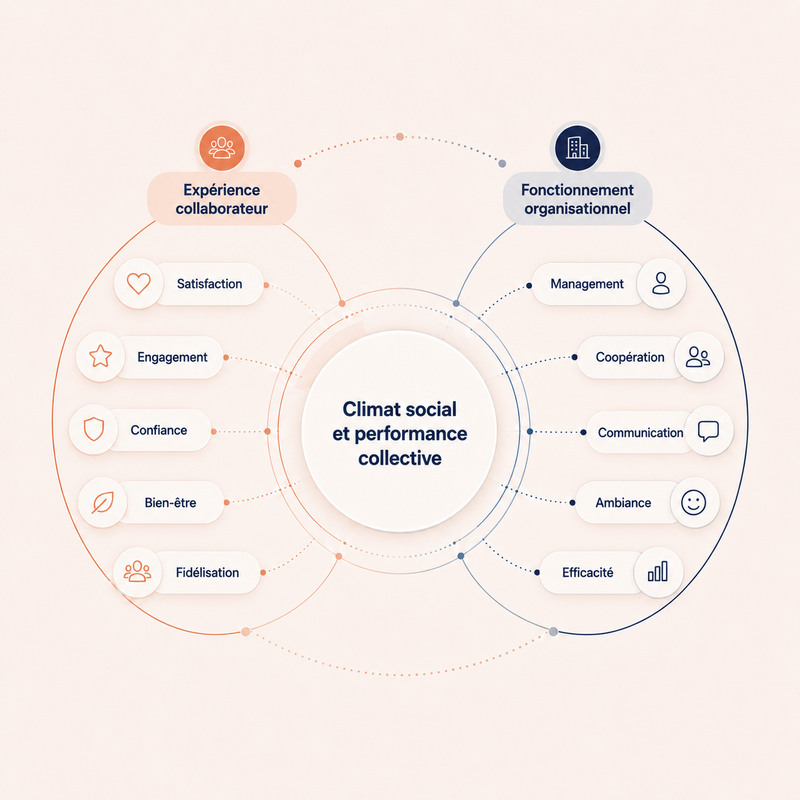
A Comprehensive View of the Employee Experience and the Organization

Our approach expands upon the traditional social barometer to analyze both the experiences of employees and the way the organization operates. It allows us to connect individual perceptions, group dynamics, and organizational realities to better understand disparities between teams, weaknesses in the work system, and drivers of sustainable performance.

  • Assess the employee experience: satisfaction, trust, engagement, well-being, retention, and long-term commitment to the organization

  • Analyze operating conditions: leadership, collaboration, communication, autonomy, recognition, and available resources

  • Identify differences in perception among leadership, managers, teams, job functions, or locations

  • Link the results to the organization’s key challenges: quality, retention, absenteeism, collective effectiveness, or change management

People-Vox Social Barometer
Ginger-SB (1)

For the past 10 years, we have been conducting our internal employee survey with People Vox every two years as part of our commitment to continuous improvement. Our employees can respond in complete confidence to share their thoughts on topics that are essential to us. People Vox has always met our expectations, provided guidance, and helped advance this initiative through their expertise […]

The added bonus: the People Vox solution allows us to benchmark ourselves against others.

Logo-groupe-ginger.svg Stéphanie Bailly, HR Director

SUPPORT

Comprehensive and personalized support

Our consultants support you every step of the way—from defining objectives to presenting the results and preparing the action plan.

01 | Defining the Scope of Your Study

Understanding your context, objectives, and target audiences in order to develop a research framework tailored to your specific challenges.

02 | Questionnaire Design

Developing or adapting the questionnaire while ensuring the clarity of the questions, methodological quality, and a positive respondent experience in order to collect reliable and usable data.

03 | Communication

Preparing communication materials for employees, managers, and labor-management partners to foster buy-in and participation.

04 | Preparing for Data Collection

Configuring the survey, filtering rules, distribution lists, access permissions, and anonymization rules to ensure a successful launch.

05 | Data Collection and Field Monitoring

Secure collection of questionnaires, tracking of participation, adjustment of follow-up reminders, and support through the completion of the study.

06 | Data Analysis and Results

Descriptive data analysis, cross-tabulations, and advanced statistical methods to identify trends, significant discrepancies, weak signals, and priorities for action.

07 | Findings & Recommendations

Production of clear and immediately actionable materials. Our mission: to transform raw data into shared insights and drivers for action.

A MULTIDIMENSIONAL DIAGNOSIS

What does a social barometer measure?

The questionnaire’s content is tailored to your organization’s objectives. It can cover the entire employee experience or delve deeper into specific, particularly strategic topics.
TOUCH
Workplace Climate and Trust
Workplace Climate and Trust Quality of internal relationships, sense of fairness, trust in the organization, and perception of social dialogue.
TOUCH
Job Content and Meaning
Job Content and Meaning The value of assignments, perceived usefulness, clarity of objectives, and understanding of one’s contribution to the collective project.
TOUCH
Organization and Workload
Organization and Workload Workload distribution, coordination, available resources, priorities, and the ability to produce high-quality work.
TOUCH
Management and Recognition
Management and Recognition Managerial support, quality feedback, recognition of work accomplished, fairness, and support for teams.
TOUCH
Cooperation and Communication
Cooperation and Communication Information sharing, mutual support, cross-functional collaboration, and the quality of relationships between departments.
TOUCH
Autonomy and Participation
Autonomy and Participation Freedom to act, the ability to take the initiative, consultation with teams, and the opportunity to contribute to decisions.
TOUCH
Professional Development and Career Path
Professional Development and Career Path Access to training, skills development, career prospects, and support for mobility.
TOUCH
Engagement and Retention
Engagement and Retention Sense of belonging, motivation, employer recommendation, intention to stay, and long-term plans within the organization.
Whiteboard Discussion
ANALYSIS THAT GOES BEYOND SCORES

Understand where to take action, with which teams, and through which channels

The value of a social barometer lies not only in the averages it produces. Our analyses help us understand the discrepancies, the relationships between the dimensions assessed, and the factors that truly influence the employee experience.
  • Segmented Results
    Compare perceptions by department, location, job role, tenure, or employee category, while adhering to confidentiality thresholds.

  • Impact analyses
    Identify the dimensions that contribute most significantly to satisfaction, engagement, retention, or other strategic indicators.

  • Trends over time
    Track changes between different survey waves and measure the perceived effects of implemented initiatives.

  • Comparative analyses
    Compare results to your previous measurements, your various business units, or relevant external benchmarks.

  • Analysis of open-ended comments
    Analyze open-ended comments to identify the concerns, expectations, and suggestions expressed by employees.

  • Mirror analyses
    Where relevant, compare employees’ perceptions with those of managers or senior leadership on the same topics.

YOUR CHALLENGES

A solution tailored to the different phases of your organization

The social barometer can be implemented as a tool for regular monitoring or to support a specific phase in the organization’s life cycle.

TOUCH
Preventing Internal Tensions
Preventing Internal Tensions Identify early warning signs, the most vulnerable groups, and issues that could undermine workplace relationships.
TOUCH
Strengthening Social Dialogue
Strengthening Social Dialogue Provide the various stakeholders with shared indicators and an objective basis for discussion.
TOUCH
Evaluating HR and Management Policies
Evaluating HR and Management Policies To measure perceptions of the initiatives undertaken in the areas of management, training, recognition, communication, and quality of life at work.
TOUCH
Track a transformation or an action plan
Track a transformation or an action plan Measure the understanding, buy-in, and perceived effects of a strategic plan, reorganization, merger, or other changes.
FAQ

Frequently Asked Questions

What is a social barometer? A workplace climate survey is a survey conducted among employees to gauge their perceptions of their work, management, internal relationships, and how the organization operates. When conducted on a regular basis, it also makes it possible to track changes in the workplace climate over time.
What are the objectives of a social barometer? It helps to objectively assess employees’ experiences, identify areas of satisfaction and difficulty, compare perceptions across different groups, and pinpoint priority actions to be taken.
What is the difference between a social barometer and an engagement survey? The engagement survey focuses primarily on involvement, commitment, and the willingness to contribute. The employee engagement survey generally covers a broader scope, including management, work organization, communication, recognition, and workplace relationships.
What is the difference between a social barometer and a QWL survey? The social barometer provides a comprehensive overview of the internal climate and the employee experience. A QWL survey delves more specifically into the conditions under which work is performed and the opportunities to influence how work is organized.
Can a social barometer be used to assess psychosocial risks? It may include certain aspects related to workload, support, autonomy, or workplace relationships. However, a dedicated assessment of psychosocial risks relies on a specific methodological framework and a more detailed analysis of exposure factors. This can be part of a supplementary module to your questionnaire.
Which indicators should be included in a social barometer? Indicators depend on the organization’s objectives. They may include satisfaction, engagement, trust, management, recognition, communication, cooperation, workload, autonomy, and intention to stay.
How many questions should the questionnaire include? There is no one-size-fits-all length. The questionnaire must be comprehensive enough to address the study’s objectives, while remaining easy for respondents to complete. At People Vox, we strive to strike a balance between the depth of the analysis and the quality of the respondent experience.
How often should a social barometer survey be conducted? An annual frequency is often appropriate for measuring structural changes. More frequent surveys may be useful during a transformation or for tracking a specific topic. The core structure of the questionnaire must remain consistent to allow for comparisons.
How can we ensure the anonymity of employees? Responses are treated confidentially, and results are presented only for groups with a sufficient number of respondents. The reporting guidelines and confidentiality thresholds are established prior to the survey launch.
How can we encourage participation in the social barometer? Participation depends, in particular, on clear communication, confidence in confidentiality, visible leadership involvement, and a report on the follow-up to previous consultations.
Can we compare results across institutions or departments? Yes, provided that confidentiality thresholds are respected. The results can be analyzed by department, business unit, location, geographic area, years of service, or other relevant criteria.
Can we reuse some questions from a previous survey? Yes. We can retain the relevant questions to preserve the comparison history, while improving the structure, wording, or scales as needed.
How long does it take to conduct a social barometer survey? The timeline depends on the size of the organization, the number of stakeholders, the complexity of the questionnaire, and the analyses required. The entire process generally extends from the scoping phase through the presentation of results, following a schedule established in advance.
How can we make use of the survey results? The results should be shared, discussed, and distilled into a limited number of priorities. The findings can be presented to senior management, managers, employee representatives, and teams to facilitate buy-in and the implementation of actions.

Going Onwards With Optimism 1

Ready to turn your employee engagement survey into a powerful management tool?


Let’s design a survey tailored to your organization to understand your employees’ experience, monitor your workplace climate, and guide your next steps.