Skip to content
PEOPLE VOX HR INSIGHTS
Analyze Data 5For the past 15 years, People Vox has been analyzing employee-employer relationships and providing insights into the major trends shaping the world of work.
COMING SOON
Work-life balance
Work-related stress
Trust in the organization’s future
Employees’ intention to stay within the organization
EMPLOYEE EXPERIENCE

Organizational Culture Survey: measure what drives behavior

People Vox maps the culture as experienced within your organization, compares it to the desired culture, and identifies the dynamics that reinforce alignment, cooperation, and performance.

  • A structured analysis of 4 dynamics and 12 dimensions
  • A comparison between the current culture and the desired culture
  • Results by team, function, location, or entity
  • Additional modules tailored to your organizational challenges
Work-Organizational-Culture
Alignment with Organizational Culture
pexels-sevenstormphotography-443383
More than 300 organizations like yours benefit from People Vox's research and consulting services
CULTURE AND ALIGNMENT

Make the processes that run through your organization visible

The organizational culture survey helps highlight how your values, priorities, and operating guidelines are reflected in your day-to-day work and decision-making.

ORGANIZATIONAL CULTURE

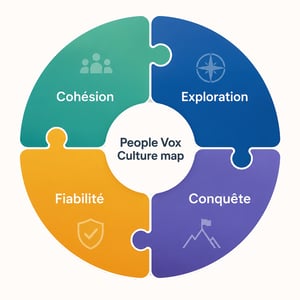
Four Key Factors for Understanding How Your Organization Works

Every organization combines several cultural logics. Their balance, intensity, and alignment with the strategy make it possible to develop a profile of your organization, understand which dynamics are actually present, which ones need to be strengthened, and which imbalances may limit collective action.

Cohesion

Growing and succeeding together: the ability to make decisions close to the front lines, to cooperate, to resolve disagreements, and to develop skills.

People Vox Culture Map-1

Exploration

Learning, experimenting, and adapting: the ability to try new approaches, listen to customers, learn from experiences, and share ideas.

Reliability

Establishing guidelines and ensuring proper execution: the ability to act with integrity, coordinate activities, and apply clear and consistent decision-making rules.

Conquest

Sharing a common direction and driving toward results: the ability to make the strategy understandable, set coherent priorities, and provide a shared vision of the future.

Ginger-SB (1)

For the past 10 years, we have been conducting our internal employee survey with People Vox every two years as part of our commitment to continuous improvement. Our employees can respond in complete confidence to share their thoughts on topics that are essential to us. People Vox has always met our expectations, provided guidance, and helped advance this initiative through their expertise […]

The added bonus: the People Vox solution allows us to benchmark ourselves against others.

Logo-groupe-ginger.svg Stéphanie Bailly, HR Director

SUPPORT

An assessment tailored to your identity and your challenges

Each project combines a stable measurement framework, customized work, and an analysis tailored to your organization’s structure, strategy, and transformations.

01 | Defining the Scope of Your Study

Understanding your context, objectives, and target audiences in order to develop a research framework tailored to your specific challenges.

02 | Interviews with Executives

Gathering insights from executives on their vision of the current culture, the desired culture, and the behaviors necessary to support the strategy.

03 | Questionnaire Design

Designing a questionnaire based on the PMeople Vox Culture Map, questions specific to your organization, and "climate" modules useful for your assessment

04 | Communication with Teams

Preparing communication materials for employees, managers, and labor-management partners to foster buy-in and participation.

05 | Data Collection and Field Monitoring

Secure collection of questionnaires, tracking of participation, adjustment of follow-up reminders, and support through the completion of the study.

06 | Cultural and Organizational Analysis

Statistical analysis of data, examination of profiles, gaps between the current and desired cultures, convergence of perceptions, and differences between units.

07 | Findings & Recommendations

Production of clear and immediately actionable materials. Our mission: to transform raw data into shared insights and drivers for action.

CULTURAL DRIVERS

Analyze what makes your culture a reality in everyday life

Culture is passed down through decisions, practices, and repeated cues. Our assessment examines the key mechanisms that either reinforce or undermine its expression in the workplace.

TOUCH
Leadership and Setting an Example
Leadership and Setting an Example The way leaders embody priorities and make trade-offs when multiple demands come into conflict.
TOUCH
Communication and Meaning
Communication and Meaning The clarity with which the strategy, mission, and expectations are explained and linked to day-to-day work.
TOUCH
Values and Behaviors
Values and Behaviors The translation of values into observable, expected, and actually practiced behaviors.
TOUCH
Rituals and Symbols
Rituals and Symbols The events, stories, customs, and identifying features that sustain collective identity.
TOUCH
Organization and Interfaces
Organization and Interfaces Consistency in structures, responsibilities, processes, and relationships between teams.
TOUCH
Recruitment and Onboarding
Recruitment and Onboarding The way in which new employees discover, understand, and internalize the organization's guiding principles.
TOUCH
Development and Mobility
Development and Mobility The skills, career paths, and profiles that the organization chooses to develop or promote.
TOUCH
Objectives and Recognition
Objectives and Recognition The behaviors that are truly valued through objectives, performance evaluations, promotions, and rewards.
LEARN MORE

An enhanced audit featuring organizational climate modules

Organizational climates reveal how policies, rules, and priorities are actually experienced within teams. We work with you to select the modules that are most relevant to your strategy, your business, and the challenges you face.

  • Innovation Climate

  • Learning Climate

  • Service Climate

  • Safety Climate

  • Psychosocial Safety Climate

  • Ethical Environment

  • Organizational Justice Climate

  • Supportive environment

  • Cross-unit cooperation climate

organizational culture
FAQ

Frequently Asked Questions

What is an organizational culture survey? An organizational culture survey analyzes the values, norms, and operating principles that actually guide behaviors and decisions. It helps bring the actual culture to light and compare it to the desired culture.
What is the difference between organizational culture and organizational climate? Culture refers to an organization’s enduring identity, its values, and its implicit norms. Organizational climates describe how certain priorities—such as safety, innovation, or cooperation—are actually experienced within a team or unit.
How does this differ from a social barometer or an engagement survey? A social barometer primarily measures individual perceptions, attitudes, and experiences. A cultural survey analyzes the collective dynamics that shape behaviors, decision-making, and the way people work together.
Can a culture really be measured? Culture can be studied through observable behaviors, practices, and perceptions. The analysis focuses on cultural profiles, the convergence of responses, and differences among populations or units.
Is the questionnaire standardized or customized? The People Vox Culture Map serves as a common foundation that ensures the consistency of the assessment. It can be supplemented with specific questions, organizational climate modules, and indicators related to your strategy.
How do you measure the desired culture? We gather feedback from executives through interviews and a dedicated questionnaire. The target cultural profile is then compared with the culture experienced by employees.
How many questions are there in the survey? The format depends on the level of detail required. A short audit may include about 30 questions, while an assessment that combines organizational culture, workplace climate, and performance indicators typically includes between 45 and 65 questions.
Can we compare multiple sites or teams? Yes. The results can be analyzed by location, business line, department, management level, or work unit, provided that confidentiality thresholds are respected.
How is the anonymity of respondents protected? Responses are collected confidentially and reported only for groups with a sufficient number of respondents. Comments are also handled with special care.
What deliverables are provided at the conclusion of the investigation? The deliverables may include a current and target cultural map, heat maps by population, a gap analysis, the results of the supplementary modules, and a prioritized roadmap.

Going Onwards With Optimism 1

Align your actual culture with the organization you want to build


Assess the dynamics that shape your organization, identify gaps between the current state and your vision, and develop a roadmap based on shared outcomes.